Keeping a Work Log Your Future Self Will Thank You For
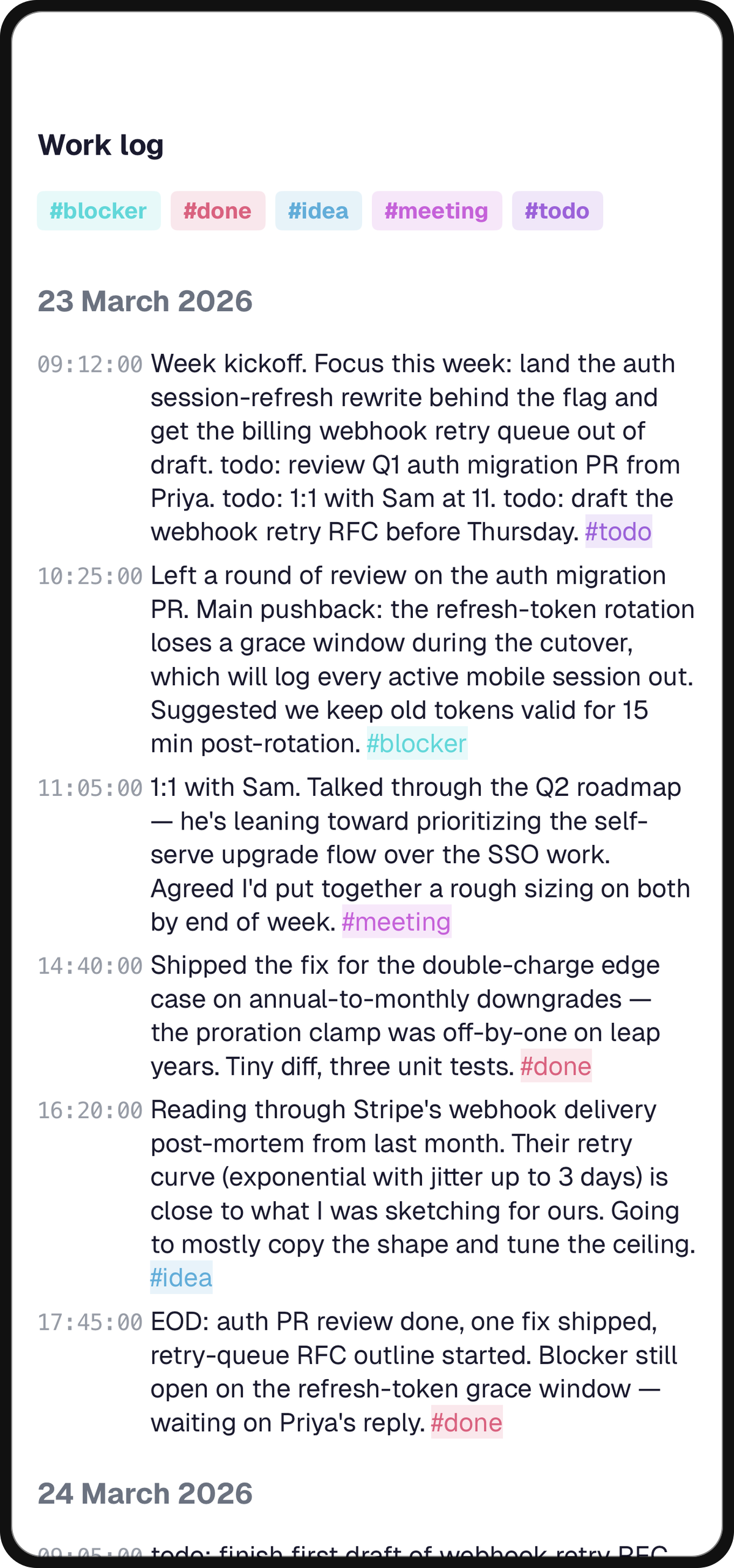
Most people who have kept a work log for more than a year describe it in roughly the same terms: it feels like a small chore until the one time it saves you. Then you keep doing it forever.
A work log isn't a to-do list and it isn't a journal. It's a timestamped record of what you actually did — written for a future version of yourself who has forgotten all of this.
What Goes in a Work Log
The bar for an entry is low: if you spent more than ten minutes on it and you might need to remember it, it goes in. One or two lines per entry, link included.
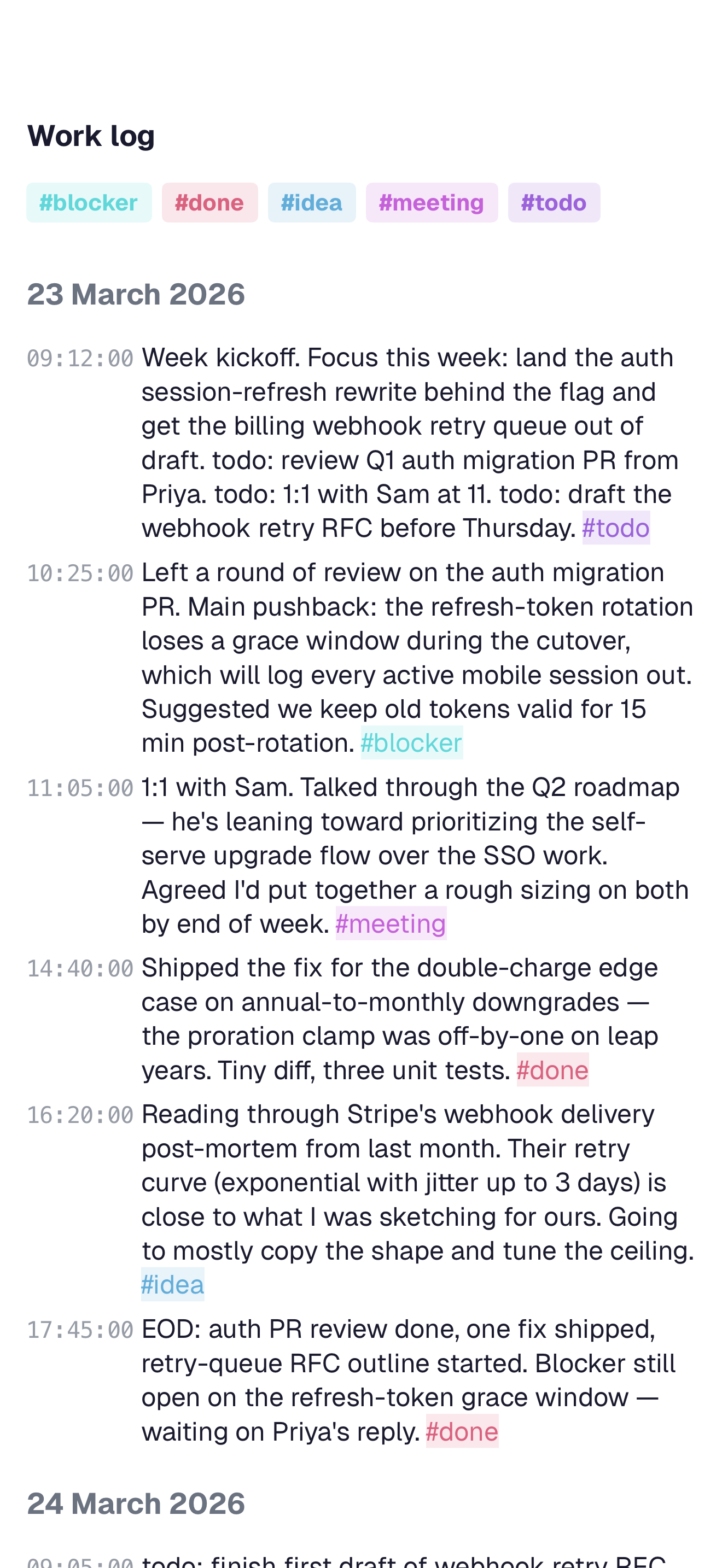
What a Good Entry Looks Like
- "Fixed the N+1 in the notes list query — was triggering on scroll into the nested entry loader."
- "Decided to defer the SSR rewrite until after payments ship. Q2 cost estimate was too high."
- "Pairing with J on the import-blog-screenshots pipeline — bash script for device-framing."
What a Bad Entry Looks Like
- "Worked on performance."
- "Meetings."
The difference is specificity. A year from now, "worked on performance" tells you nothing; "fixed the N+1 in the notes list query" drops you right back into the context.
Write It Daily, Review It Monthly
The log is cheapest when you add to it as you go, not at end-of-day.
Thirty Seconds Per Entry, Added in Real Time
Close a PR, add a line. Finish a debugging session, add a line. The cost per entry is under thirty seconds — which is exactly why the habit survives busy weeks.
Monthly, Not Weekly, for the Review
Once a month, read the last four weeks in one sitting. You're looking for two things:
- What took way longer than you expected (so you can estimate better next time)
- What you'd completely forgotten (so you know what's worth surfacing in a standup, a review, or an engineering blog post)
When the Work Log Earns Its Keep
Four situations, in descending order of how much you'll be glad you have it:
Performance Reviews and Promotion Packets
Trying to remember six months of work from calendar entries and commit history is a nightmare. The work log is the document. You copy-paste from it.
Writing a Doc, Post, or Post-Mortem
Every good architecture doc, post-mortem, or engineering post I've ever written started as a work-log search.
Debugging a Bug That Came Back
"Didn't I see this six weeks ago?" Search the log for the error message — you probably did.
Explaining Your Week to Someone
Manager, partner, skip-level, future self on Monday morning. The log hands you the recap for free.
Tip
Thirty seconds a day. The only real trap is starting so elaborately that you burn out — a plain chronological list of one-line entries beats any template you'll invent on day one.
Related Articles
Append-and-Review: A Better Way to Use a Notes App
Most notes apps reward creating more notes. A better approach: append to existing notes during the week, then run a short review pass to promote what matters.
The Simplest Daily Journal App: One Note Per Day
Why a single note per day — timestamped, append-only, and reviewed weekly — is the lowest-friction journaling setup that actually sticks.
A Meeting Notes App That Stays Out of Your Way
Most meeting notes get filed and forgotten. A simple append-only note per meeting, tagged by attendee and linked to the work it affects, gets read again.